Family of Boy Falls From Ski Lift Vancouver Wa
F or centuries western culture has been permeated by the idea that humans are selfish creatures. That contemptuous image of humanity has been proclaimed in films and novels, history books and scientific research. But in the final 20 years, something extraordinary has happened. Scientists from all over the world have switched to a more hopeful view of mankind. This development is still and so young that researchers in unlike fields often don't fifty-fifty know virtually each other.
When I started writing a book near this more hopeful view, I knew there was one story I would have to address. It takes place on a deserted island somewhere in the Pacific. A plane has but gone down. The only survivors are some British schoolboys, who tin't believe their skillful fortune. Goose egg merely beach, shells and water for miles. And improve nevertheless: no grownups.
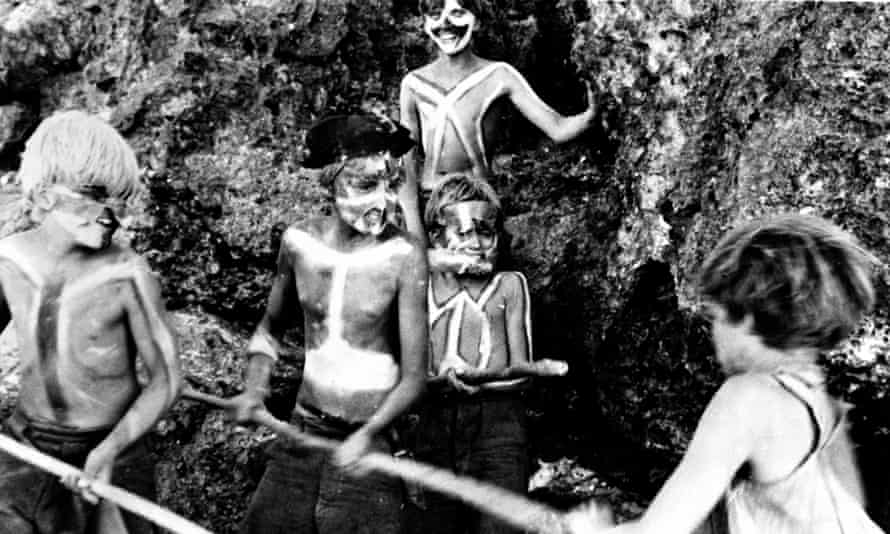
On the very offset day, the boys plant a democracy of sorts. 1 male child, Ralph, is elected to exist the grouping's leader. Able-bodied, charismatic and handsome, his game plan is uncomplicated: 1) Have fun. 2) Survive. 3) Make smoke signals for passing ships. Number one is a success. The others? Not and then much. The boys are more than interested in feasting and frolicking than in disposed the fire. Before long, they have begun painting their faces. Casting off their clothes. And they develop overpowering urges – to pinch, to kick, to bite.
By the time a British naval officer comes ashore, the island is a smouldering wasteland. Iii of the children are dead. "I should take idea," the officer says, "that a pack of British boys would have been able to put up a better show than that." At this, Ralph bursts into tears. "Ralph wept for the finish of innocence," we read, and for "the darkness of man's heart".
This story never happened. An English schoolmaster, William Golding, made upwards this story in 1951 – his novel Lord of the Flies would sell tens of millions of copies, be translated into more thirty languages and hailed equally one of the classics of the 20th century. In hindsight, the secret to the volume'southward success is clear. Golding had a masterful ability to portray the darkest depths of mankind. Of form, he had the zeitgeist of the 1960s on his side, when a new generation was questioning its parents about the atrocities of the second world state of war. Had Auschwitz been an anomaly, they wanted to know, or is in that location a Nazi hiding in each of us?
I first read Lord of the Flies equally a teenager. I recollect feeling disillusioned after, but non for a second did I retrieve to doubt Golding'due south view of human being nature. That didn't happen until years later when I began delving into the author's life. I learned what an unhappy individual he had been: an alcoholic, prone to low. "I accept always understood the Nazis," Golding confessed, "considering I am of that sort past nature." And it was "partly out of that sad self-knowledge" that he wrote Lord of the Flies.
I began to wonder: had anyone ever studied what real children would do if they found themselves lone on a deserted island? I wrote an commodity on the subject, in which I compared Lord of the Flies to modernistic scientific insights and concluded that, in all probability, kids would act very differently. Readers responded sceptically. All my examples concerned kids at home, at school, or at summertime army camp. Thus began my quest for a existent-life Lord of the Flies. Later on trawling the web for a while, I came across an obscure blog that told an arresting story: "One solar day, in 1977, six boys set out from Tonga on a fishing trip ... Caught in a huge tempest, the boys were shipwrecked on a deserted island. What do they practice, this little tribe? They fabricated a pact never to quarrel."
The article did not provide any sources. Merely sometimes all information technology takes is a stroke of luck. Sifting through a newspaper archive one day, I typed a year incorrectly and there it was. The reference to 1977 turned out to have been a typo. In the half dozen October 1966 edition of Australian newspaper The Age, a headline jumped out at me: "Sunday showing for Tongan castaways". The story concerned half dozen boys who had been constitute 3 weeks earlier on a rocky islet due south of Tonga, an island grouping in the Pacific Body of water. The boys had been rescued by an Australian sea captain after being marooned on the island of 'Ata for more than than a twelvemonth. According to the article, the captain had fifty-fifty got a television station to film a re-enactment of the boys' adventure.
I was bursting with questions. Were the boys all the same alive? And could I find the television footage? Nearly importantly, though, I had a lead: the captain'due south name was Peter Warner. When I searched for him, I had another stroke of luck. In a contempo event of a tiny local newspaper from Mackay, Commonwealth of australia, I came across the headline: "Mates share 50-yr bond". Printed alongside was a small photograph of two men, smile, i with his arm slung effectually the other. The article began: "Deep in a assistant plantation at Tullera, most Lismore, sit down an unlikely pair of mates ... The elder is 83 years old, the son of a wealthy industrialist. The younger, 67, was, literally, a child of nature." Their names? Peter Warner and Mano Totau. And where had they met? On a deserted island.
My married woman Maartje and I rented a machine in Brisbane and some 3 hours afterwards arrived at our destination, a spot in the middle of nowhere that stumped Google Maps. Yet in that location he was, sitting out in front of a low-slung firm off the clay road: the man who rescued six lost boys fifty years ago, Captain Peter Warner.
Peter was the youngest son of Arthur Warner, once one of the richest and virtually powerful men in Australia. Back in the 1930s, Arthur ruled over a vast empire called Electronic Industries, which dominated the country'south radio market place at the fourth dimension. Peter was groomed to follow in his father'southward footsteps. Instead, at the age of 17, he ran away to sea in search of hazard and spent the next few years sailing from Hong Kong to Stockholm, Shanghai to St Petersburg. When he finally returned 5 years later, the prodigal son proudly presented his father with a Swedish helm's certificate. Unimpressed, Warner Sr demanded his son larn a useful profession. "What's easiest?" Peter asked. "Accountancy," Arthur lied.
Peter went to piece of work for his begetter's company, notwithstanding the sea still beckoned, and whenever he could he went to Tasmania, where he kept his own fishing armada. It was this that brought him to Tonga in the winter of 1966. On the style dwelling house he took a little detour and that's when he saw information technology: a minuscule isle in the azure sea, 'Ata. The isle had been inhabited in one case, until i dark solar day in 1863, when a slave transport appeared on the horizon and sailed off with the natives. Since and so, 'Ata had been deserted – cursed and forgotten.
Simply Peter noticed something odd. Peering through his binoculars, he saw burned patches on the green cliffs. "In the tropics it'south unusual for fires to first spontaneously," he told us, a one-half century later. Then he saw a male child. Naked. Hair down to his shoulders. This wild creature leaped from the cliffside and plunged into the water. All of a sudden more boys followed, screaming at the tiptop of their lungs. It didn't have long for the beginning boy to achieve the boat. "My proper noun is Stephen," he cried in perfect English. "In that location are six of us and we reckon we've been here 15 months."
The boys, once aboard, claimed they were students at a boarding schoolhouse in Nuku'alofa, the Tongan capital. Ill of school meals, they had decided to have a line-fishing boat out one day, but to become caught in a storm. Likely story, Peter thought. Using his ii-way radio, he chosen in to Nuku'alofa. "I've got six kids hither," he told the operator. "Stand by," came the response. Xx minutes ticked by. (Equally Peter tells this part of the story, he gets a piffling misty-eyed.) Finally, a very tearful operator came on the radio, and said: "You found them! These boys accept been given upward for dead. Funerals accept been held. If it'south them, this is a miracle!"
In the months that followed I tried to reconstruct as precisely as possible what had happened on 'Ata. Peter'due south retentiveness turned out to exist excellent. Fifty-fifty at the historic period of 90, everything he recounted was consistent with my foremost other source, Mano, fifteen years old at the time and at present pushing lxx, who lived simply a few hours' drive from him. The existent Lord of the Flies, Mano told the states, began in June 1965. The protagonists were six boys – Sione, Stephen, Kolo, David, Luke and Mano – all pupils at a strict Catholic boarding schoolhouse in Nuku'alofa. The oldest was 16, the youngest 13, and they had one principal affair in mutual: they were bored witless. And then they came up with a plan to escape: to Fiji, some 500 miles abroad, or fifty-fifty all the style to New Zealand.
There was only one obstruction. None of them owned a boat, so they decided to "borrow" i from Mr Taniela Uhila, a fisherman they all disliked. The boys took piddling time to gear up for the voyage. Ii sacks of bananas, a few coconuts and a small gas burner were all the supplies they packed. It didn't occur to whatsoever of them to bring a map, let lonely a compass.
No 1 noticed the small craft leaving the harbour that evening. Skies were fair; but a mild breeze ruffled the calm sea. But that night the boys made a grave fault. They roughshod asleep. A few hours later they awoke to water crashing down over their heads. It was dark. They hoisted the canvas, which the wind promptly tore to shreds. Adjacent to break was the rudder. "We drifted for eight days," Mano told me. "Without food. Without water." The boys tried catching fish. They managed to collect some rainwater in hollowed-out coconut shells and shared information technology as between them, each taking a sip in the forenoon and some other in the evening.
Then, on the 8th 24-hour interval, they spied a miracle on the horizon. A minor island, to be precise. Non a tropical paradise with waving palm copse and sandy beaches, merely a hulking mass of stone, jutting upward more than a thou feet out of the ocean. These days, 'Ata is considered uninhabitable. Only "by the time nosotros arrived," Captain Warner wrote in his memoirs, "the boys had set up a small commune with food garden, hollowed-out tree trunks to store rainwater, a gymnasium with curious weights, a badminton court, chicken pens and a permanent fire, all from handiwork, an onetime knife blade and much determination." While the boys in Lord of the Flies come to blows over the burn down, those in this existent-life version tended their flame and so information technology never went out, for more than a twelvemonth.
The kids agreed to work in teams of two, drawing up a strict roster for garden, kitchen and guard duty. Sometimes they quarrelled, but whenever that happened they solved information technology by imposing a fourth dimension-out. Their days began and ended with song and prayer. Kolo fashioned a makeshift guitar from a piece of driftwood, half a kokosnoot trounce and six steel wires salvaged from their wrecked boat – an instrument Peter has kept all these years – and played it to help elevator their spirits. And their spirits needed lifting. All summer long information technology hardly rained, driving the boys frantic with thirst. They tried amalgam a raft in social club to leave the island, only it cruel autonomously in the crashing surf.
Worst of all, Stephen slipped i day, fell off a cliff and broke his leg. The other boys picked their way downwardly after him and then helped him back up to the top. They prepare his leg using sticks and leaves. "Don't worry," Sione joked. "Nosotros'll exercise your work, while you lie in that location like King Taufa'ahau Tupou himself!"
They survived initially on fish, coconuts, tame birds (they drank the blood as well as eating the meat); seabird eggs were sucked dry. Later, when they got to the acme of the island, they institute an ancient volcanic crater, where people had lived a century before. At that place the boys discovered wild taro, bananas and chickens (which had been reproducing for the 100 years since the last Tongans had left).
They were finally rescued on Dominicus 11 September 1966. The local physician later expressed astonishment at their muscled physiques and Stephen's perfectly healed leg. Just this wasn't the finish of the boys' little adventure, considering, when they arrived back in Nuku'alofa law boarded Peter'south gunkhole, arrested the boys and threw them in jail. Mr Taniela Uhila, whose sailing gunkhole the boys had "borrowed" 15 months earlier, was however furious, and he'd decided to press charges.
Fortunately for the boys, Peter came up with a plan. It occurred to him that the story of their shipwreck was perfect Hollywood material. And being his father'southward corporate accountant, Peter managed the visitor's film rights and knew people in Boob tube. And so from Tonga, he called upward the director of Channel 7 in Sydney. "You tin can accept the Australian rights," he told them. "Give me the world rights." Next, Peter paid Mr Uhila £150 for his old gunkhole, and got the boys released on condition that they would cooperate with the movie. A few days later, a team from Channel seven arrived.
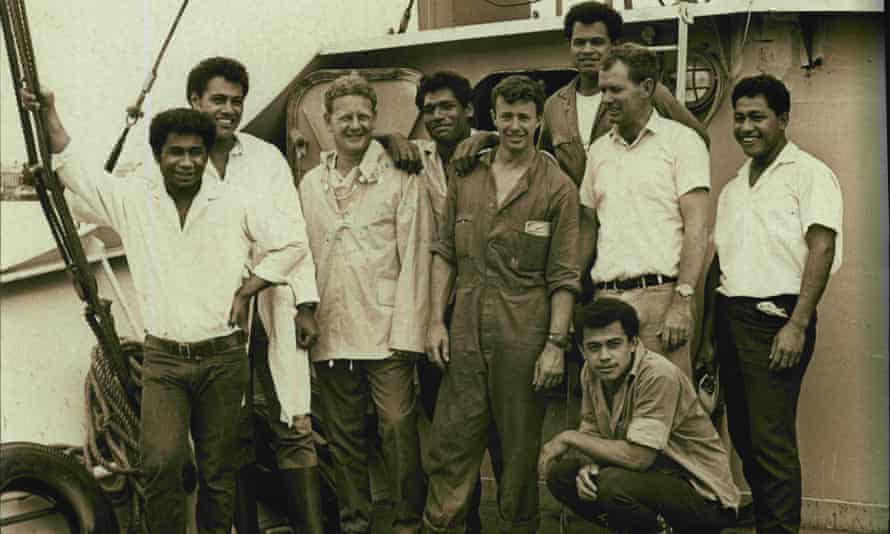
The mood when the boys returned to their families in Tonga was jubilant. About the entire isle of Haʻafeva – population 900 – had turned out to welcome them home. Peter was proclaimed a national hero. Soon he received a message from King Taufa'ahau Tupou Four himself, inviting the captain for an audience. "Thanks for rescuing six of my subjects," His Royal Highness said. "At present, is there anything I can do for y'all?" The captain didn't have to think long. "Yes! I would like to trap lobster in these waters and start a business here." The king consented. Peter returned to Sydney, resigned from his father's company and commissioned a new ship. Then he had the six boys brought over and granted them the thing that had started it all: an opportunity to run into the world beyond Tonga. He hired them as the coiffure of his new fishing gunkhole.
While the boys of 'Ata have been consigned to obscurity, Golding's volume is yet widely read. Media historians even credit him as being the unwitting originator of 1 of the almost popular entertainment genres on television today: reality Idiot box. "I read and reread Lord of the Flies ," divulged the creator of hit series Survivor in an interview.Information technology'southward fourth dimension we told a different kind of story. The real Lord of the Flies is a tale of friendship and loyalty; i that illustrates how much stronger we are if we can lean on each other. After my wife took Peter'due south picture, he turned to a cabinet and rummaged around for a bit, then drew out a heavy stack of papers that he laid in my hands. His memoirs, he explained, written for his children and grandchildren. I looked down at the commencement page. "Life has taught me a great deal," it began, "including the lesson that y'all should always look for what is skilful and positive in people."
This is an adapted excerpt from Rutger Bregman'south Humankind, translated by Elizabeth Manton and Erica Moore. A alive streamed Q&A with Bregman and Owen Jones takes identify at 7pm on nineteen May 2020.
Source: https://www.theguardian.com/books/2020/may/09/the-real-lord-of-the-flies-what-happened-when-six-boys-were-shipwrecked-for-15-months
0 Response to "Family of Boy Falls From Ski Lift Vancouver Wa"
Post a Comment