Review You Have Two Steel Solid Spheres Sphere 2 Has Twice the Radius of Sphere 1
ten Fixed-Axis Rotation
10.v Computing Moments of Inertia
Learning Objectives
By the end of this section, you lot will be able to:
- Calculate the moment of inertia for uniformly shaped, rigid bodies
- Utilise the parallel axis theorem to discover the moment of inertia virtually any axis parallel to one already known
- Calculate the moment of inertia for compound objects
In the preceding section, nosotros defined the moment of inertia but did not show how to calculate it. In this section, we show how to calculate the moment of inertia for several standard types of objects, besides as how to use known moments of inertia to find the moment of inertia for a shifted axis or for a compound object. This section is very useful for seeing how to apply a full general equation to circuitous objects (a skill that is critical for more advanced physics and engineering courses).
Moment of Inertia
Nosotros defined the moment of inertia I of an object to be
![\[I=\sum _{i}{m}_{i}{r}_{i}^{2}\]](https://opentextbc.ca/universityphysicsv1openstax/wp-content/ql-cache/quicklatex.com-ccf44d963677e7315439abd7e8fd7e42_l3.png "Rendered by QuickLaTeX.com")
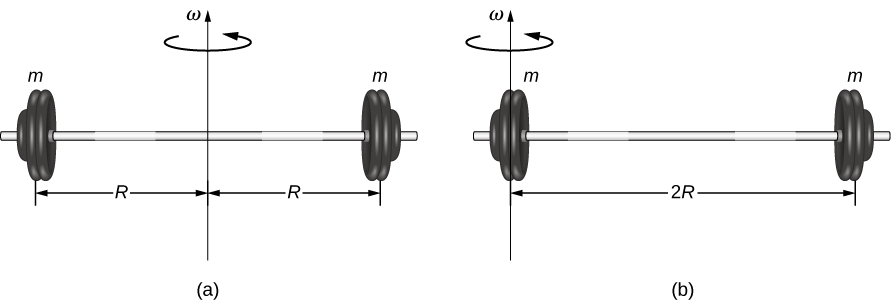
for all the betoken masses that make up the object. Because r is the distance to the axis of rotation from each slice of mass that makes upward the object, the moment of inertia for any object depends on the chosen axis. To run into this, permit'due south take a simple example of ii masses at the end of a massless (negligibly small mass) rod ((Figure)) and calculate the moment of inertia about ii different axes. In this case, the summation over the masses is uncomplicated because the ii masses at the end of the barbell tin can be approximated as indicate masses, and the sum therefore has just two terms.
In the case with the axis in the heart of the barbell, each of the two masses chiliad is a distance R away from the axis, giving a moment of inertia of
![\[{I}_{1}=m{R}^{2}+m{R}^{2}=2m{R}^{2}.\]](https://opentextbc.ca/universityphysicsv1openstax/wp-content/ql-cache/quicklatex.com-59238699567ea6ddc8388536a87872f7_l3.png "Rendered by QuickLaTeX.com")
In the example with the axis at the cease of the barbell—passing through 1 of the masses—the moment of inertia is
![\[{I}_{2}=m{(0)}^{2}+m{(2R)}^{2}=4m{R}^{2}.\]](https://opentextbc.ca/universityphysicsv1openstax/wp-content/ql-cache/quicklatex.com-ed31c385d9ff16664a203e363f756d01_l3.png "Rendered by QuickLaTeX.com")
From this result, we tin can conclude that it is twice as hard to rotate the barbell virtually the cease than about its middle.
In this example, we had two point masses and the sum was simple to summate. Withal, to bargain with objects that are non indicate-like, we need to retrieve carefully about each of the terms in the equation. The equation asks us to sum over each 'piece of mass' a certain altitude from the centrality of rotation. But what exactly does each 'slice of mass' mean? Call up that in our derivation of this equation, each piece of mass had the same magnitude of velocity, which means the whole piece had to have a single distance r to the axis of rotation. However, this is not possible unless we take an infinitesimally small piece of mass dm, as shown in (Figure).
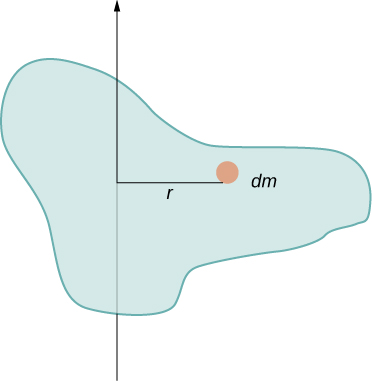
The need to use an infinitesimally pocket-size slice of mass dm suggests that we can write the moment of inertia by evaluating an integral over minute masses rather than doing a discrete sum over finite masses:
![\[I=\sum _{i}{m}_{i}{r}_{i}{}^{2}\enspace\text{becomes}I=\int {r}^{2}dm.\]](https://opentextbc.ca/universityphysicsv1openstax/wp-content/ql-cache/quicklatex.com-e8b3795fef5668c39e4db0f84b87c0d8_l3.png "Rendered by QuickLaTeX.com")
This, in fact, is the course we need to generalize the equation for complex shapes. It is best to work out specific examples in detail to go a feel for how to calculate the moment of inertia for specific shapes. This is the focus of almost of the remainder of this section.
A uniform sparse rod with an axis through the heart
Consider a compatible (density and shape) thin rod of mass M and length Fifty as shown in (Figure). We want a thin rod so that we can presume the cross-sectional area of the rod is minor and the rod can be thought of equally a string of masses along a one-dimensional straight line. In this example, the axis of rotation is perpendicular to the rod and passes through the midpoint for simplicity. Our job is to calculate the moment of inertia about this axis. Nosotros orient the axes so that the z-axis is the axis of rotation and the x-axis passes through the length of the rod, as shown in the figure. This is a user-friendly option because we tin then integrate along the x-axis.
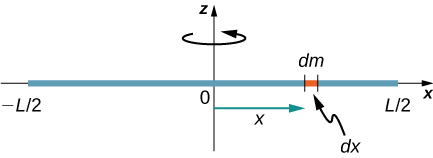
We ascertain dm to be a small element of mass making upwardly the rod. The moment of inertia integral is an integral over the mass distribution. However, we know how to integrate over infinite, not over mass. We therefore need to find a manner to relate mass to spatial variables. We do this using the linear mass density
![\[\lambda\]](https://opentextbc.ca/universityphysicsv1openstax/wp-content/ql-cache/quicklatex.com-ab40e408da0bd057cd6a2beecd9fb7c4_l3.png "Rendered by QuickLaTeX.com")
of the object, which is the mass per unit length. Since the mass density of this object is uniform, we can write
![\[\lambda =\frac{m}{l}\enspace\text{or}m=\lambda l.\]](https://opentextbc.ca/universityphysicsv1openstax/wp-content/ql-cache/quicklatex.com-a588c2060bc19d089e74c2dd31c3a327_l3.png "Rendered by QuickLaTeX.com")
If we take the differential of each side of this equation, we notice
![\[dm=d(\lambda l)=\lambda (dl)\]](https://opentextbc.ca/universityphysicsv1openstax/wp-content/ql-cache/quicklatex.com-73155f16633015330d0822637a316f3e_l3.png "Rendered by QuickLaTeX.com")
since
is constant. Nosotros chose to orient the rod along the x-axis for convenience—this is where that option becomes very helpful. Note that a slice of the rod dl lies completely along the x-axis and has a length dx; in fact,
![\[dl=dx\]](https://opentextbc.ca/universityphysicsv1openstax/wp-content/ql-cache/quicklatex.com-d4f4bac2f881b90c74fb71b2c89946d6_l3.png "Rendered by QuickLaTeX.com")
in this situation. We can therefore write
![\[dm=\lambda (dx)\]](https://opentextbc.ca/universityphysicsv1openstax/wp-content/ql-cache/quicklatex.com-4f87c512195794e45bbc802b51f46c6f_l3.png "Rendered by QuickLaTeX.com")
, giving us an integration variable that we know how to deal with. The distance of each piece of mass dm from the axis is given by the variable x, as shown in the figure. Putting this all together, we obtain
![\[I=\int {r}^{2}dm=\int {x}^{2}dm=\int {x}^{2}\lambda dx.\]](https://opentextbc.ca/universityphysicsv1openstax/wp-content/ql-cache/quicklatex.com-8d70873d04a0e37400b1a97e5c4630f0_l3.png "Rendered by QuickLaTeX.com")
The terminal stride is to be careful nearly our limits of integration. The rod extends from
![\[x=\text{−}L\text{/}2\]](https://opentextbc.ca/universityphysicsv1openstax/wp-content/ql-cache/quicklatex.com-0cf7ad499afae127b80a725c18b1c9d5_l3.png "Rendered by QuickLaTeX.com")
to
![\[x=L\text{/}2\]](https://opentextbc.ca/universityphysicsv1openstax/wp-content/ql-cache/quicklatex.com-ef067ddc7da66ffbf9d2a72825c1b423_l3.png "Rendered by QuickLaTeX.com")
, since the axis is in the eye of the rod at
![\[x=0\]](https://opentextbc.ca/universityphysicsv1openstax/wp-content/ql-cache/quicklatex.com-756a0fa8a6211eb21a7149fa425df6e5_l3.png "Rendered by QuickLaTeX.com")
. This gives us
![\[\begin{array}{cc}\hfill I& =\underset{\text{−}L\text{/}2}{\overset{L\text{/}2}{\int }}{x}^{2}\lambda dx=\lambda \frac{{x}^{3}}{3}{|}_{\text{−}L\text{/}2}^{L\text{/}2}=\lambda (\frac{1}{3})[{(\frac{L}{2})}^{3}-{(\frac{\text{−}L}{2})}^{3}]\hfill \\ & =\lambda (\frac{1}{3})\frac{{L}^{3}}{8}(2)=\frac{M}{L}(\frac{1}{3})\frac{{L}^{3}}{8}(2)=\frac{1}{12}M{L}^{2}.\hfill \end{array}\]](https://opentextbc.ca/universityphysicsv1openstax/wp-content/ql-cache/quicklatex.com-3ab1986192ac808f9e310e52faf10dfd_l3.png "Rendered by QuickLaTeX.com")
Next, we calculate the moment of inertia for the aforementioned uniform sparse rod but with a different axis pick so we can compare the results. We would wait the moment of inertia to be smaller nearly an axis through the center of mass than the endpoint axis, just as it was for the barbell instance at the starting time of this section. This happens because more mass is distributed farther from the axis of rotation.
A compatible sparse rod with axis at the cease
At present consider the same compatible sparse rod of mass M and length 50, but this time nosotros move the centrality of rotation to the finish of the rod. Nosotros wish to find the moment of inertia about this new axis ((Figure)). The quantity dm is once more divers to exist a modest element of mass making upwards the rod. Just every bit before, we obtain
However, this fourth dimension nosotros have different limits of integration. The rod extends from
to
![\[x=L\]](https://opentextbc.ca/universityphysicsv1openstax/wp-content/ql-cache/quicklatex.com-718cc9ed602817fc7635fcd561149d89_l3.png "Rendered by QuickLaTeX.com")
, since the centrality is at the end of the rod at
. Therefore we find
![\[\begin{array}{cc}\hfill I& =\underset{0}{\overset{L}{\int }}{x}^{2}\lambda dx=\lambda \frac{{x}^{3}}{3}{|}_{0}^{L}=\lambda (\frac{1}{3})[{(L)}^{3}-{(0)}^{3}]\hfill \\ & =\lambda (\frac{1}{3}){L}^{3}=\frac{M}{L}(\frac{1}{3}){L}^{3}=\frac{1}{3}M{L}^{2}.\hfill \end{array}\]](https://opentextbc.ca/universityphysicsv1openstax/wp-content/ql-cache/quicklatex.com-a31bf77c836ffc607ca915032ca41501_l3.png "Rendered by QuickLaTeX.com")
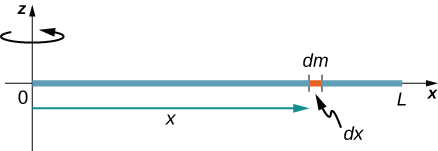
Notation the rotational inertia of the rod about its endpoint is larger than the rotational inertia nearly its heart (consistent with the barbell case) past a cistron of four.
The Parallel-Axis Theorem
The similarity between the process of finding the moment of inertia of a rod near an axis through its middle and nearly an centrality through its stop is striking, and suggests that there might exist a simpler method for determining the moment of inertia for a rod nigh any axis parallel to the axis through the eye of mass. Such an axis is called a parallel centrality. There is a theorem for this, called the parallel-axis theorem, which we state hither just practise not derive in this text.
Parallel-Axis Theorem
Let m be the mass of an object and let d be the distance from an axis through the object's center of mass to a new axis. Then we have
![\[{I}_{\text{parallel-axis}}={I}_{\text{center of mass}}+m{d}^{2}.\]](https://opentextbc.ca/universityphysicsv1openstax/wp-content/ql-cache/quicklatex.com-e54f92d76fda2dd3d4e2fa7a4a25c09c_l3.png "Rendered by QuickLaTeX.com")
Allow's use this to the rod examples solved in a higher place:
![\[{I}_{\text{end}}={I}_{\text{center of mass}}+m{d}^{2}=\frac{1}{12}m{L}^{2}+m{(\frac{L}{2})}^{2}=(\frac{1}{12}+\frac{1}{4})m{L}^{2}=\frac{1}{3}m{L}^{2}.\]](https://opentextbc.ca/universityphysicsv1openstax/wp-content/ql-cache/quicklatex.com-770e45e5e2c8a84528ee5b66de7d0d2e_l3.png "Rendered by QuickLaTeX.com")
This result agrees with our more lengthy calculation from above. This is a useful equation that we employ in some of the examples and issues.
Bank check Your Understanding
What is the moment of inertia of a cylinder of radius R and mass m most an axis through a point on the surface, as shown below?
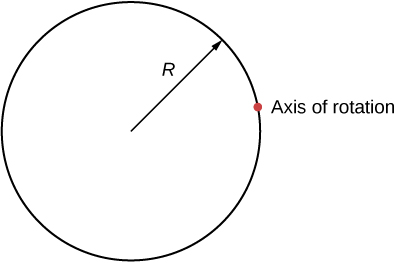
[reveal-respond q="530534″]Bear witness Reply[/reveal-respond]
[hidden-answer a="530534″]
![\[{I}_{\text{parallel-axis}}={I}_{\text{center of mass}}+m{d}^{2}=m{R}^{2}+m{R}^{2}=2m{R}^{2}\]](https://opentextbc.ca/universityphysicsv1openstax/wp-content/ql-cache/quicklatex.com-68590209a005757d496f8758e7b488f8_l3.png "Rendered by QuickLaTeX.com")
[/subconscious-answer]
A compatible thin disk about an centrality through the middle
Integrating to find the moment of inertia of a two-dimensional object is a petty bit trickier, merely one shape is usually done at this level of written report—a uniform thin disk nearly an axis through its eye ((Figure)).
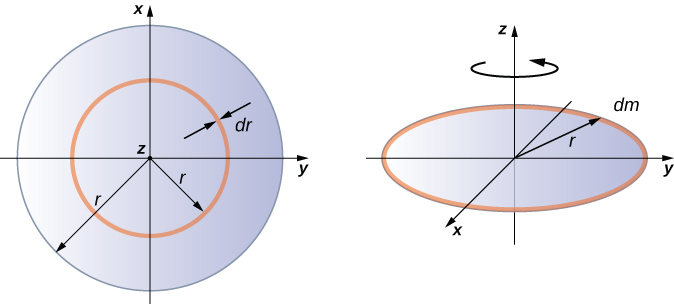
Since the disk is thin, we can take the mass as distributed entirely in the xy-plane. We again outset with the relationship for the surface mass density, which is the mass per unit of measurement surface area. Since it is uniform, the surface mass density
![\[\sigma\]](https://opentextbc.ca/universityphysicsv1openstax/wp-content/ql-cache/quicklatex.com-668d55b962235eb08e8c2c53b6033310_l3.png "Rendered by QuickLaTeX.com")
is constant:
![\[\sigma =\frac{m}{A}\quad \text{or}\quad \sigma A=m,\,\text{so}\,dm=\sigma (dA).\]](https://opentextbc.ca/universityphysicsv1openstax/wp-content/ql-cache/quicklatex.com-ccc6318f8e30421a31f81a86660dfe12_l3.png "Rendered by QuickLaTeX.com")
Now we use a simplification for the surface area. The area can be thought of as made upwards of a serial of thin rings, where each ring is a mass increment dm of radius r equidistanct from the axis, as shown in part (b) of the figure. The infinitesimal area of each band dA is therefore given past the length of each ring (
![\[2\pi r\]](https://opentextbc.ca/universityphysicsv1openstax/wp-content/ql-cache/quicklatex.com-698e86d0b8fb958c56f09bf2a277b41e_l3.png "Rendered by QuickLaTeX.com")
) times the infinitesimmal width of each ring dr:
![\[A=\pi {r}^{2},dA=d(\pi {r}^{2})=\pi d{r}^{2}=2\pi rdr.\]](https://opentextbc.ca/universityphysicsv1openstax/wp-content/ql-cache/quicklatex.com-7454616065db0edf63c00d1c09ea1707_l3.png "Rendered by QuickLaTeX.com")
The full area of the disk is then made up from adding all the thin rings with a radius range from 0 to R. This radius range and so becomes our limits of integration for dr, that is, we integrate from
![\[r=0\]](https://opentextbc.ca/universityphysicsv1openstax/wp-content/ql-cache/quicklatex.com-e328532cc2840b49e9a9058cb082b8c1_l3.png "Rendered by QuickLaTeX.com")
to
![\[r=R\]](https://opentextbc.ca/universityphysicsv1openstax/wp-content/ql-cache/quicklatex.com-5904e8794585a05cadcf3e5b0d0fa118_l3.png "Rendered by QuickLaTeX.com")
. Putting this all together, we have
![\[\begin{array}{cc}\hfill I& =\underset{0}{\overset{R}{\int }}{r}^{2}\sigma (2\pi r)dr=2\pi \sigma \underset{0}{\overset{R}{\int }}{r}^{3}dr=2\pi \sigma \frac{{r}^{4}}{4}{|}_{0}^{R}=2\pi \sigma (\frac{{R}^{4}}{4}-0)\hfill \\ & =2\pi \frac{m}{A}(\frac{{R}^{4}}{4})=2\pi \frac{m}{\pi {R}^{2}}(\frac{{R}^{4}}{4})=\frac{1}{2}m{R}^{2}.\hfill \end{array}\]](https://opentextbc.ca/universityphysicsv1openstax/wp-content/ql-cache/quicklatex.com-8618811a2536ded6b69c8122860e46c7_l3.png "Rendered by QuickLaTeX.com")
Note that this agrees with the value given in (Effigy).
Calculating the moment of inertia for compound objects
At present consider a compound object such equally that in (Figure), which depicts a thin disk at the end of a sparse rod. This cannot exist hands integrated to find the moment of inertia because information technology is not a uniformly shaped object. All the same, if nosotros go back to the initial definition of moment of inertia as a summation, we can reason that a compound object's moment of inertia tin be plant from the sum of each part of the object:
![\[{I}_{\text{total}}=\sum _{i}{I}_{i}.\]](https://opentextbc.ca/universityphysicsv1openstax/wp-content/ql-cache/quicklatex.com-c42e6d76ffad0b396799711af66a010e_l3.png "Rendered by QuickLaTeX.com")
It is of import to notation that the moments of inertia of the objects in (Figure) are virtually a common axis. In the case of this object, that would be a rod of length L rotating about its end, and a thin disk of radius R rotating about an axis shifted off of the center past a distance
![\[L+R\]](https://opentextbc.ca/universityphysicsv1openstax/wp-content/ql-cache/quicklatex.com-819b67abaa5715c5964550261c91cb43_l3.png "Rendered by QuickLaTeX.com")
, where R is the radius of the deejay. Let'due south define the mass of the rod to be
![\[{m}_{\text{r}}\]](https://opentextbc.ca/universityphysicsv1openstax/wp-content/ql-cache/quicklatex.com-866c918c853b61edead317fccaff6d2c_l3.png "Rendered by QuickLaTeX.com")
and the mass of the disk to be
![\[{m}_{\text{d}}.\]](https://opentextbc.ca/universityphysicsv1openstax/wp-content/ql-cache/quicklatex.com-ee61a7f98ccff3a56e08e2f8a3cabd54_l3.png "Rendered by QuickLaTeX.com")
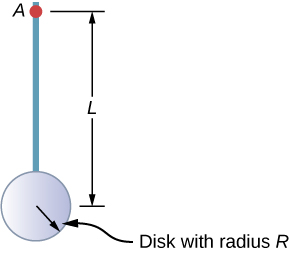
The moment of inertia of the rod is merely
![\[\frac{1}{3}{m}_{\text{r}}{L}^{2}\]](https://opentextbc.ca/universityphysicsv1openstax/wp-content/ql-cache/quicklatex.com-01d7b29b496ab9788d0d54883757f842_l3.png "Rendered by QuickLaTeX.com")
, just we have to use the parallel-axis theorem to find the moment of inertia of the disk about the axis shown. The moment of inertia of the disk near its eye is
![\[\frac{1}{2}{m}_{\text{d}}{R}^{2}\]](https://opentextbc.ca/universityphysicsv1openstax/wp-content/ql-cache/quicklatex.com-77127e2de09e71d77d8d1d7e9d3a837c_l3.png "Rendered by QuickLaTeX.com")
and we apply the parallel-axis theorem
![\[{I}_{\text{parallel-axis}}={I}_{\text{center of mass}}+m{d}^{2}\]](https://opentextbc.ca/universityphysicsv1openstax/wp-content/ql-cache/quicklatex.com-340227e44c3b0939562f8a9537da205d_l3.png "Rendered by QuickLaTeX.com")
to discover
![\[{I}_{\text{parallel-axis}}=\frac{1}{2}{m}_{\text{d}}{R}^{2}+{m}_{\text{d}}{(L+R)}^{2}.\]](https://opentextbc.ca/universityphysicsv1openstax/wp-content/ql-cache/quicklatex.com-1a92487ff328bf303a0e36b1fa668f5d_l3.png "Rendered by QuickLaTeX.com")
Adding the moment of inertia of the rod plus the moment of inertia of the disk with a shifted axis of rotation, we find the moment of inertia for the chemical compound object to be
![\[{I}_{\text{total}}=\frac{1}{3}{m}_{\text{r}}{L}^{2}+\frac{1}{2}{m}_{\text{d}}{R}^{2}+{m}_{\text{d}}{(L+R)}^{2}.\]](https://opentextbc.ca/universityphysicsv1openstax/wp-content/ql-cache/quicklatex.com-19c3045578d782c88f839b85c510fdb9_l3.png "Rendered by QuickLaTeX.com")
Applying moment of inertia calculations to solve problems
Now let's examine some practical applications of moment of inertia calculations.
Case
Person on a Merry-Go-Circular
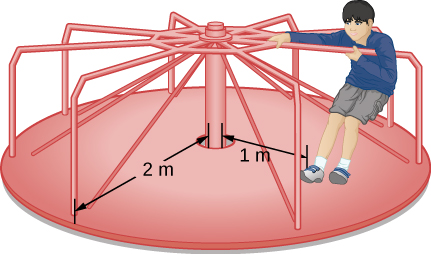
A 25-kg child stands at a distance
![\[r=1.0\,\text{m}\]](https://opentextbc.ca/universityphysicsv1openstax/wp-content/ql-cache/quicklatex.com-dddcc7fdd1946ea1d9f43b9ce6fb405c_l3.png "Rendered by QuickLaTeX.com")
from the axis of a rotating merry-go-round ((Effigy)). The merry-go-circular tin exist approximated as a uniform solid disk with a mass of 500 kg and a radius of 2.0 m. Find the moment of inertia of this organisation.
Strategy
This problem involves the calculation of a moment of inertia. We are given the mass and altitude to the axis of rotation of the child equally well as the mass and radius of the merry-go-round. Since the mass and size of the child are much smaller than the merry-go-circular, we can approximate the child as a point mass. The notation we utilize is
![\[{m}_{\text{c}}=25\,\text{kg},{r}_{\text{c}}=1.0\,\text{m},{m}_{\text{m}}=500\,\text{kg},{r}_{\text{m}}=2.0\,\text{m}\]](https://opentextbc.ca/universityphysicsv1openstax/wp-content/ql-cache/quicklatex.com-96cefa18e5603f2505820b0a09ee6b55_l3.png "Rendered by QuickLaTeX.com")
.
Our goal is to discover
![\[{I}_{\text{total}}=\sum _{i}{I}_{i}\]](https://opentextbc.ca/universityphysicsv1openstax/wp-content/ql-cache/quicklatex.com-cfb779b3a5bc3c10bb7ddea0785b298b_l3.png "Rendered by QuickLaTeX.com")
.
Solution
For the child,
![\[{I}_{\text{c}}={m}_{\text{c}}{r}^{2}\]](https://opentextbc.ca/universityphysicsv1openstax/wp-content/ql-cache/quicklatex.com-2347ca61a4cc0beab3bc47c55e787ee4_l3.png "Rendered by QuickLaTeX.com")
, and for the merry-get-round,
![\[{I}_{\text{m}}=\frac{1}{2}{m}_{\text{m}}{r}^{2}\]](https://opentextbc.ca/universityphysicsv1openstax/wp-content/ql-cache/quicklatex.com-2da47dbcfd784cf3268bb8a619374189_l3.png "Rendered by QuickLaTeX.com")
. Therefore
![\[{I}_{\text{total}}=25{(1)}^{2}+\frac{1}{2}(500){(2)}^{2}=25+1000=1025\,\text{kg}·{\text{m}}^{2}.\]](https://opentextbc.ca/universityphysicsv1openstax/wp-content/ql-cache/quicklatex.com-d2a11332cb4998de67ab8bda6c3638ea_l3.png "Rendered by QuickLaTeX.com")
Significance
The value should be close to the moment of inertia of the merry-go-round by itself because it has much more than mass distributed away from the axis than the child does.
Instance
Rod and Solid Sphere
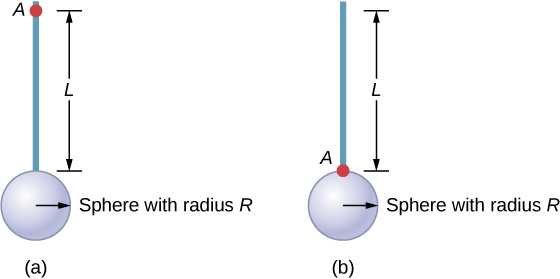
Find the moment of inertia of the rod and solid sphere combination well-nigh the two axes as shown below. The rod has length 0.5 g and mass 2.0 kg. The radius of the sphere is 20.0 cm and has mass 1.0 kg.
Strategy
Since nosotros accept a compound object in both cases, we can use the parallel-centrality theorem to find the moment of inertia about each axis. In (a), the center of mass of the sphere is located at a altitude
from the axis of rotation. In (b), the center of mass of the sphere is located a distance R from the axis of rotation. In both cases, the moment of inertia of the rod is about an axis at one terminate. Refer to (Figure) for the moments of inertia for the private objects.
-
![\[{I}_{\text{total}}=\sum _{i}{I}_{i}={I}_{\text{Rod}}+{I}_{\text{Sphere}}\]](https://opentextbc.ca/universityphysicsv1openstax/wp-content/ql-cache/quicklatex.com-caf57af8d65ed8c6ab9a948159b67631_l3.png "Rendered by QuickLaTeX.com")
;
![\[{I}_{\text{Sphere}}={I}_{\text{center of mass}}+{m}_{\text{Sphere}}{(L+R)}^{2}=\frac{2}{5}{m}_{\text{Sphere}}{R}^{2}+{m}_{\text{Sphere}}{(L+R)}^{2}\]](https://opentextbc.ca/universityphysicsv1openstax/wp-content/ql-cache/quicklatex.com-87b3d0d2ea3a04f2bf714303e6250306_l3.png "Rendered by QuickLaTeX.com")
;
![\[{I}_{\text{total}}={I}_{\text{Rod}}+{I}_{\text{Sphere}}=\frac{1}{3}{m}_{\text{Rod}}{L}^{2}+\frac{2}{5}{m}_{\text{Sphere}}{R}^{2}+{m}_{\text{Sphere}}{(L+R)}^{2};\]](https://opentextbc.ca/universityphysicsv1openstax/wp-content/ql-cache/quicklatex.com-1317fd8b4e7055d987f8a753fcd51531_l3.png "Rendered by QuickLaTeX.com")
![\[{I}_{\text{total}}=\frac{1}{3}(2.0\,\text{kg}){(0.5\,\text{m})}^{2}+\frac{2}{5}(1.0\,\text{kg})(0.2\,{\text{m})}^{2}+(1.0\,\text{kg}){(0.5\,\text{m}+0.2\,\text{m})}^{2};\]](https://opentextbc.ca/universityphysicsv1openstax/wp-content/ql-cache/quicklatex.com-9a49b67814683951c8dc2d8d8501af96_l3.png "Rendered by QuickLaTeX.com")
![\[{I}_{\text{total}}=(0.167+0.016+0.490)\,\text{kg}·{\text{m}}^{2}=0.673\,\text{kg}·{\text{m}}^{2}.\]](https://opentextbc.ca/universityphysicsv1openstax/wp-content/ql-cache/quicklatex.com-5770d023e210204ce4cfcba191d65636_l3.png "Rendered by QuickLaTeX.com")
-
![\[{I}_{\text{Sphere}}=\frac{2}{5}{m}_{\text{Sphere}}{R}^{2}+{m}_{\text{Sphere}}{R}^{2}\]](https://opentextbc.ca/universityphysicsv1openstax/wp-content/ql-cache/quicklatex.com-be678294ed8c540c7fa0a5e1c59dfb7e_l3.png "Rendered by QuickLaTeX.com")
;
![\[{I}_{\text{total}}={I}_{\text{Rod}}+{I}_{\text{Sphere}}=\frac{1}{3}{m}_{\text{Rod}}{L}^{2}+\frac{2}{5}{m}_{\text{Sphere}}{R}^{2}+{m}_{\text{Sphere}}{R}^{2}\]](https://opentextbc.ca/universityphysicsv1openstax/wp-content/ql-cache/quicklatex.com-235f39e668041eb0c05f2d0315fffd44_l3.png "Rendered by QuickLaTeX.com")
;
![\[{I}_{\text{total}}=\frac{1}{3}(2.0\,\text{kg}){(0.5\,\text{m})}^{2}+\frac{2}{5}(1.0\,\text{kg})(0.2\,{\text{m})}^{2}+(1.0\,\text{kg}){(0.2\,\text{m})}^{2}\]](https://opentextbc.ca/universityphysicsv1openstax/wp-content/ql-cache/quicklatex.com-9dbb8928f558135c83421c2409ac556e_l3.png "Rendered by QuickLaTeX.com")
;
![\[{I}_{\text{total}}=(0.167+0.016+0.04)\,\text{kg}·{\text{m}}^{2}=0.223\,\text{kg}·{\text{m}}^{2}.\]](https://opentextbc.ca/universityphysicsv1openstax/wp-content/ql-cache/quicklatex.com-bf99ea6fe1feffb25720923242debbba_l3.png "Rendered by QuickLaTeX.com")
Significance
Using the parallel-axis theorem eases the computation of the moment of inertia of compound objects. We see that the moment of inertia is greater in (a) than (b). This is considering the axis of rotation is closer to the heart of mass of the arrangement in (b). The simple analogy is that of a rod. The moment of inertia about one end is
![\[\frac{1}{3}m{L}^{2}\]](https://opentextbc.ca/universityphysicsv1openstax/wp-content/ql-cache/quicklatex.com-8ca6d7ce02b710af4f8ff7270c6c7d47_l3.png "Rendered by QuickLaTeX.com")
, merely the moment of inertia through the centre of mass forth its length is
![\[\frac{1}{12}m{L}^{2}\]](https://opentextbc.ca/universityphysicsv1openstax/wp-content/ql-cache/quicklatex.com-caeb0d296a73f15b9e572d38c4eefe61_l3.png "Rendered by QuickLaTeX.com")
.
Example
Angular Velocity of a Pendulum
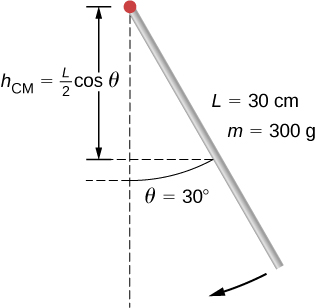
A pendulum in the shape of a rod ((Figure)) is released from rest at an bending of
![\[30\text{°}\]](https://opentextbc.ca/universityphysicsv1openstax/wp-content/ql-cache/quicklatex.com-c94934d8a2dddef67c8b7502e575de0e_l3.png "Rendered by QuickLaTeX.com")
. It has a length thirty cm and mass 300 g. What is its angular velocity at its everyman signal?
![\[30\text{°}.\]](https://opentextbc.ca/universityphysicsv1openstax/wp-content/ql-cache/quicklatex.com-a3e484fbcf5d6b45b6cbeb7207c585a9_l3.png "Rendered by QuickLaTeX.com")
Strategy
Utilize conservation of energy to solve the problem. At the betoken of release, the pendulum has gravitational potential energy, which is determined from the height of the heart of mass above its lowest indicate in the swing. At the lesser of the swing, all of the gravitational potential energy is converted into rotational kinetic energy.
Solution
The change in potential energy is equal to the change in rotational kinetic energy,
![\[\Delta U+\Delta K=0\]](https://opentextbc.ca/universityphysicsv1openstax/wp-content/ql-cache/quicklatex.com-1423e909cc7b74a7717ee1ec5747b26a_l3.png "Rendered by QuickLaTeX.com")
.
At the top of the swing:
![\[U=mg{h}_{\text{cm}}=mg\frac{L}{2}(\text{cos}\,\theta )\]](https://opentextbc.ca/universityphysicsv1openstax/wp-content/ql-cache/quicklatex.com-8e5bf742e8dfc7a8c23ba9fd30c072df_l3.png "Rendered by QuickLaTeX.com")
. At the bottom of the swing,
![\[U=mg\frac{L}{2}.\]](https://opentextbc.ca/universityphysicsv1openstax/wp-content/ql-cache/quicklatex.com-61abc3f9285fef1c6a47c4294e40fdcb_l3.png "Rendered by QuickLaTeX.com")
At the top of the swing, the rotational kinetic energy is
![\[K=0\]](https://opentextbc.ca/universityphysicsv1openstax/wp-content/ql-cache/quicklatex.com-2e6864e120c5210cae4ebb8b1c689bc0_l3.png "Rendered by QuickLaTeX.com")
. At the bottom of the swing,
![\[K=\frac{1}{2}I{\omega }^{2}\]](https://opentextbc.ca/universityphysicsv1openstax/wp-content/ql-cache/quicklatex.com-3a34fbdea32374bf8b38937dc47b6896_l3.png "Rendered by QuickLaTeX.com")
. Therefore:
![\[\text{Δ}U+\text{Δ}K=0⇒(mg\frac{L}{2}(1-\text{cos}\,\theta )-0)+(0-\frac{1}{2}I{\omega }^{2})=0\]](https://opentextbc.ca/universityphysicsv1openstax/wp-content/ql-cache/quicklatex.com-0b45f13aa3e1bf34b1f44c0d4949bb5d_l3.png "Rendered by QuickLaTeX.com")
or
![\[\frac{1}{2}I{\omega }^{2}=mg\frac{L}{2}(1-\text{cos}\,\theta ).\]](https://opentextbc.ca/universityphysicsv1openstax/wp-content/ql-cache/quicklatex.com-0a0c84f780edd284f35355d3c91ceff4_l3.png "Rendered by QuickLaTeX.com")
Solving for
![\[\omega\]](https://opentextbc.ca/universityphysicsv1openstax/wp-content/ql-cache/quicklatex.com-231d76a1dcdb84e30834c95bc7591fce_l3.png "Rendered by QuickLaTeX.com")
, we have
![\[\omega =\sqrt{mg\frac{L}{I}(1-\text{cos}\,\theta )}=\sqrt{mg\frac{L}{1\text{/}3m{L}^{2}}(1-\text{cos}\,\theta )}=\sqrt{g\frac{3}{L}(1-\text{cos}\,\theta )}.\]](https://opentextbc.ca/universityphysicsv1openstax/wp-content/ql-cache/quicklatex.com-adc050d1170189f293e6b01b7818328c_l3.png "Rendered by QuickLaTeX.com")
Inserting numerical values, we have
![\[\omega =\sqrt{9.8\,\text{m}\text{/}{\text{s}}^{2}\frac{3}{0.3\,\text{m}}(1-\text{cos}\,30)}=3.6\,\text{rad}\text{/}\text{s}.\]](https://opentextbc.ca/universityphysicsv1openstax/wp-content/ql-cache/quicklatex.com-993ad56048553e11c030ca57aa2f74e8_l3.png "Rendered by QuickLaTeX.com")
Significance
Notation that the athwart velocity of the pendulum does not depend on its mass.
Summary
- Moments of inertia tin can exist institute by summing or integrating over every 'piece of mass' that makes up an object, multiplied by the square of the altitude of each 'piece of mass' to the axis. In integral grade the moment of inertia is
![\[I=\int {r}^{2}dm\]](https://opentextbc.ca/universityphysicsv1openstax/wp-content/ql-cache/quicklatex.com-fdd33bda42d82668294846363d82ae79_l3.png "Rendered by QuickLaTeX.com")
.
- Moment of inertia is larger when an object'south mass is farther from the axis of rotation.
- It is possible to find the moment of inertia of an object about a new axis of rotation once it is known for a parallel centrality. This is called the parallel axis theorem given by
, where d is the distance from the initial centrality to the parallel axis.
- Moment of inertia for a compound object is simply the sum of the moments of inertia for each individual object that makes up the chemical compound object.
Conceptual Questions
If a child walks toward the center of a merry-go-round, does the moment of inertia increment or decrease?
A discus thrower rotates with a discus in his mitt before letting it go. (a) How does his moment of inertia alter afterwards releasing the discus? (b) What would be a expert approximation to utilise in calculating the moment of inertia of the discus thrower and discus?
[reveal-respond q="fs-id1167133845959″]Show Solution[/reveal-respond]
[hidden-respond a="fs-id1167133845959″]
a. It decreases. b. The arms could be approximated with rods and the discus with a disk. The torso is most the axis of rotation so it doesn't contribute much to the moment of inertia.
[/subconscious-answer]
Does increasing the number of blades on a propeller increase or decrease its moment of inertia, and why?
The moment of inertia of a long rod spun around an axis through i end perpendicular to its length is
![\[m{L}^{2}\text{/}3\]](https://opentextbc.ca/universityphysicsv1openstax/wp-content/ql-cache/quicklatex.com-f8e059373d881fc35b28312a1a767306_l3.png "Rendered by QuickLaTeX.com")
. Why is this moment of inertia greater than it would be if yous spun a bespeak mass chiliad at the location of the center of mass of the rod (at L/two) (that would be
![\[m{L}^{2}\text{/}4\]](https://opentextbc.ca/universityphysicsv1openstax/wp-content/ql-cache/quicklatex.com-dd4c68962405d7e85cc125c79a486bf7_l3.png "Rendered by QuickLaTeX.com")
)?
[reveal-answer q="fs-id1167133354662″]Show Solution[/reveal-answer]
[hidden-answer a="fs-id1167133354662″]
Because the moment of inertia varies equally the foursquare of the distance to the axis of rotation. The mass of the rod located at distances greater than Fifty/2 would provide the larger contribution to make its moment of inertia greater than the bespeak mass at L/two.
[/subconscious-respond]
Why is the moment of inertia of a hoop that has a mass M and a radius R greater than the moment of inertia of a disk that has the same mass and radius?
Problems
While punting a football, a kicker rotates his leg nearly the hip joint. The moment of inertia of the leg is
![\[3.75{\,\text{kg-m}}^{2}\]](https://opentextbc.ca/universityphysicsv1openstax/wp-content/ql-cache/quicklatex.com-176491a3a38fe7a6c6114573ac27effb_l3.png "Rendered by QuickLaTeX.com")
and its rotational kinetic energy is 175 J. (a) What is the angular velocity of the leg? (b) What is the velocity of tip of the punter's shoe if it is ane.05 k from the hip articulation?
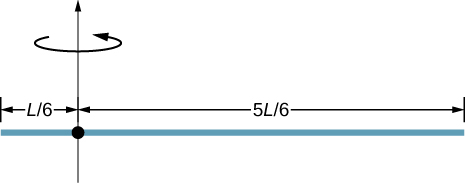
Using the parallel centrality theorem, what is the moment of inertia of the rod of mass 1000 about the centrality shown below?
[reveal-answer q="96051″]Evidence Answer[/reveal-answer]
[subconscious-answer a="96051″]
![\[I=\frac{7}{36}m{L}^{2}\]](https://opentextbc.ca/universityphysicsv1openstax/wp-content/ql-cache/quicklatex.com-f7178c47c8949995ff120bb8d15090d2_l3.png "Rendered by QuickLaTeX.com")
[/hidden-respond]
Notice the moment of inertia of the rod in the previous problem past direct integration.
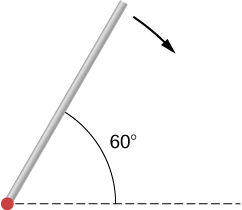
A uniform rod of mass 1.0 kg and length 2.0 m is free to rotate well-nigh 1 cease (see the following figure). If the rod is released from residual at an angle of
![\[60\text{°}\]](https://opentextbc.ca/universityphysicsv1openstax/wp-content/ql-cache/quicklatex.com-9ed7cbabc9ada23cb96d44819c58f695_l3.png "Rendered by QuickLaTeX.com")
with respect to the horizontal, what is the speed of the tip of the rod as it passes the horizontal position?
[reveal-answer q="71295″]Show Answer[/reveal-reply]
[hidden-answer a="71295″]
![\[v=7.14\,\text{m}\text{/}\text{s}.\]](https://opentextbc.ca/universityphysicsv1openstax/wp-content/ql-cache/quicklatex.com-49acfda450383d8a2db7ef70d069540b_l3.png "Rendered by QuickLaTeX.com")
[/subconscious-answer]
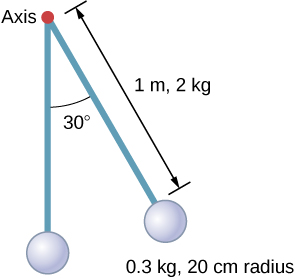
A pendulum consists of a rod of mass 2 kg and length ane m with a solid sphere at 1 end with mass 0.three kg and radius xx cm (see the following effigy). If the pendulum is released from rest at an angle of
, what is the athwart velocity at the everyman point?
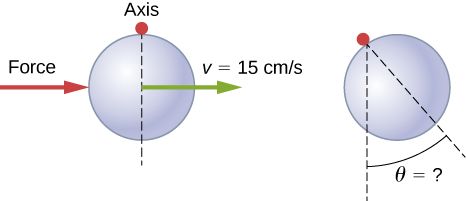
A solid sphere of radius x cm is allowed to rotate freely about an centrality. The sphere is given a precipitous blow so that its center of mass starts from the position shown in the post-obit figure with speed 15 cm/southward. What is the maximum angle that the bore makes with the vertical?
[reveal-respond q="602090″]Testify Answer[/reveal-answer]
[subconscious-answer a="602090″]
![\[\theta =10.2\text{°}\]](https://opentextbc.ca/universityphysicsv1openstax/wp-content/ql-cache/quicklatex.com-bbbc277bf5c6ab2f9eab64f7d31838f9_l3.png "Rendered by QuickLaTeX.com")
[/hidden-respond]
Summate the moment of inertia by direct integration of a thin rod of mass Grand and length L nearly an centrality through the rod at Fifty/three, equally shown below. Cheque your answer with the parallel-axis theorem.

Glossary
- linear mass density
- the mass per unit length
of a one dimensional object
- parallel axis
- axis of rotation that is parallel to an axis about which the moment of inertia of an object is known
- parallel-axis theorem
- if the moment of inertia is known for a given axis, it can be found for any axis parallel to it
- surface mass density
- mass per unit surface area
of a ii dimensional object
Source: https://opentextbc.ca/universityphysicsv1openstax/chapter/10-5-calculating-moments-of-inertia/
0 Response to "Review You Have Two Steel Solid Spheres Sphere 2 Has Twice the Radius of Sphere 1"
Post a Comment