S Art of the Deal Ghostwriter Said That the President Would ââåmurder as Many Enemies as North Korea
The discussion of the foibles and failures of modernistic fine art that appeared here 2 weeks ago was of course non the last discussion on that vast and intricate subject. This week I want to take the give-and-take further, starting from a deceptively simple question: what is art for? What's the point or purpose of all these odd, impractical aspects of human civilisation we call the arts?
In the gimmicky industrial world in that location are three commonplace answers to that question, and a great deal of the absurdity and ugliness that passes for art these days is a direct result of the coaction between the first two of those answers. Let's have them one at a time.
 The first of them, the one you'll most often hear from people who think they have art seriously, is that art is a vehicle for self-expression. Whose self, though, gets expressed? That's a loaded question. On the one hand, you take the merits that there are certain very special people who are so bursting with creative oomph, or alternatively and then tormented by emotions far more interesting than yours and mine, that annihilation they make is fine art, just because they're the ones who brand it. If a seven-twelvemonth-old boy finds a discarded urinal and hangs it on a wall, that'due south a prank, only when Marcel Duchamp did it, the result was a work of art. Why? Considering he was Marcel Duchamp, that's why, and undiluted artsyness oozed out of every pore of his body. This view is understandably very popular among professional artists, who similar to recall that all the student loans they took out to get their MFAs guarantee them a corresponding land of specialness.
On the other manus, you have the claim that everybody is an artist, that everybody ought to express themselves whether or non they take any scrap of talent or technical skill, and so we all ought to take turns politely applauding each other's creations, no affair how awful those may be. This is the attitude that gives rise to the enthusiastic mediocrity of the Neopagan bardic circles we discussed two weeks ago: if everybody is just equally much of an artist as anybody else, and making people feel good about their creative product is all that matters, then you lot're pretty much guaranteed a race to the bottom in which everyone who values quality finds somewhere else to be, leaving the field to poetry that would gag a Vogon, with musical accompaniment to match. This view is understandably very popular amid people who are bad at art, since information technology gives them an excuse to merits that their art actually is just as good as anyone else'southward.
Clearly, then, both versions of the claim that cocky-expression is the purpose of art have serious downsides. It might exist possible to finesse the issue one way or another while still preserving the claim, but it'due south been tried over and over over again for something like a century now with very dubious results—I'm thinking here, among other things, of all the years Arthur Danto put into trying to craft a theory of art that would make room for disused urinals, not to mention Andy Warhol'due south hilarious jokes at the expense of the fine art scene. Nonetheless flawed the theory of fine art as self-expression might be, though, information technology'southward a proficient deal less problematic than the second commonplace respond I desire to discuss, which is that fine art exists to produce assets for investment.
In calling this a commonplace theory of art, I'm stretching the point a bit, because you won't hear many people saying this out loud in public. On the other manus, information technology dominates the way that fine arts are actually produced and marketed in the industrial world today. Especially simply not only on the high-priced end of the art world, paintings, sculptures, and the similar are bought and sold in exactly the same spirit, and for exactly the same motives, equally stocks, bonds, and other financial assets are traded. These days, people with money want to find something to serve as a shop of wealth, and where in that location's a demand, there will inevitably exist a supply—even if what's being marketed as a fashion to store wealth has no intrinsic worth at all.
And so far, this mode of thinking about art is mostly confined to painting, sculpture, and those other arts that typically find their way into art museums. A few musicians have figured out how to cash in on the aforementioned marketplace—the group Wu-Tang Clan, for example, has recorded at to the lowest degree one album of which at that place is only one copy in existence, for sale as an investment asset at a stratospheric price—and of course writers have been turning out expensive express editions of their work for a long time now. No dubiety other arts volition get into the market place before the fad runs its course.
The entire contemporary fixation on finding means to shop wealth, mind you, is a sign of serious economic dysfunction. In a healthy economy, people with money to spare put it into investments that produce wealth, and thus get a bigger share of the pie by helping brand the pie larger. One of the bright red flashing lights alert of severe trouble in the modernistic industrial world is that in many countries—the U.s.a. among them—the barriers to productive economic activity have risen and then loftier that near investment money goes into unproductive avails instead. Instead of helping to produce wealth, these avails merely shop it. More precisely, they store a notional merits on wealth, which may or may non be convertible into actual wealth when push comes to shove.
We'll talk another fourth dimension about how the barriers to productive economic action got there and whose interests they serve. The point I desire to make hither is that in an economy such every bit ours, where people are trying to store wealth rather than produce it, anything that in theory will proceed its value over the long term can exist turned into an investment asset. That's not simply a theoretical statement, either; correct at present, just about anything collectible that has a price worth noticing is being snapped up as an investment nugget by somebody or other. My judge is that this entire process is post-obit the familiar dynamics of a speculative bubble, and a vast corporeality of the modern art, antique furniture, old baseball trading cards, and other alleged stores of wealth will end upwardly being worth far less than their current face value once the marketplace for stores of wealth peaks and the panic selling begins; still, we'll run into.
Here again, though, I want to focus on the affect such shenanigans have on art. The Large Name Painter we discussed two weeks ago, who presides over an artistic sweatshop and does nix to the paintings that are supposedly his but sign his name to them, is a successful manufacturer of investment vehicles, non an creative person in whatever sense that matters. Even in terms of the definition discussed above, that of fine art as self-expression, he falls apartment; the just matter being expressed by his artistic sweatshop is that memorable maxim of Ben Franklin's about a fool and his coin. There are enough of other people busily expressing that aforementioned maxim, in and out of the arts scene; I admit to a sure preference for those who don't pretend to be artists, equally by and large they're less pompous about their moneygrubbing than those who practice.
Let'south move on to the third commonplace reply about the purpose of fine art. The offset two are more often than not found among professional artists, those who purchase works by professional artists, and those who aspire to belong to one of these two categories. The third is found amid those—the great majority these days—who take no interest in the highbrow world of artists and art critics, who don't merits to know fine art, merely simply know what they like. Their thesis, as often equally not expressed in so many words, is that the purpose of art is to provide enjoyment to its audience.
That's a theory of art that professional artists and their bookish hangers-on beloved to denounce, just it's honest, and information technology reflects a straightforward reality. Outside of the narrow confines of the fine-art industry and its clientele, nearly people who buy a painting do so because they recall they will relish looking at information technology. The vast majority of people heed to the kinds of music they do, read the books they practice, take in the plays and movies and other performances they do, considering they bask these things. What's more, they very often spend as much as they tin can afford on these things, and since they outnumber the clientele of the fine arts by myriads to one, their theory of art has serious economic consequences; a painting by a Big Proper name Painter costs a lot more than a cheap paperback novel, but only the highest echelon of Big Name Painters tin can count on equaling or exceeding the annual income of a reasonably successful writer of pop novels.
Perchance the greatest strength of the enjoyment theory of fine art is that information technology applies just equally finer to highbrow as to lowbrow fine art. In that location are, afterwards all, indirect as well as direct means of enjoyment. The truck driver or waitress reading a trashy novel gets direct enjoyment out of information technology, and the aforementioned can be said of the very few readers these days who can honestly take in avant-garde literature for the pleasure of it. For those who can't, though, avant-garde literature offers an indirect enjoyment, in that its readers can preen themselves on not being the kind of people who relish trashy novels. Snobbery is a source of enjoyment, after all, and a great many works of art these days are explicitly designed to provide serious snob value to their purchasers.
The difficulty with this theory is simply that it doesn't explain enough. It's an interesting fact of the history of the arts that many of the best artistic and critical minds of modern times, people who had or have a neat enjoyment of the highest stop of artistic creation, also have had a robust appetite for lowbrow trash. William Butler Yeats is a favorite example of mine: i of the greatest poets in the English linguistic communication, and the winner of a well-deserved Nobel Prize in literature, he also delighted in cheap detective thrillers. I don't call back anyone has always suggested that he valued them every bit much as he valued serious literature, or that he dislocated the two; he enjoyed them in different ways. More than precisely, he got 1 kind of enjoyment from both of them, but a 2d kind of enjoyment out of the serious literature solitary.
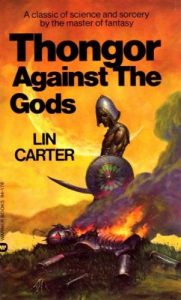 This isn't an uncommon feel, and it happens to many readers as they become older. I'll utilise myself as an instance. As a boy and a immature human, I adored trashy fantasy novels, and got a vast corporeality of enjoyment out of even the trashiest. (Lin Carter, I'm looking at y'all.) The literary stop of the fantasy genre, by dissimilarity, baffled me and left me cold. These days, after another thirty years of reading, the sometime is still truthful but the latter is non; I nonetheless delight in the trashy fantasy of my insufficiently misspent youth, but these days I tin can besides take down a volume of Eastward.R. Eddison's Zimiamvian trilogy, say, and lose an evening in that very literary piece of work of fantasy fiction. What'due south more, I get something out of Eddison's richly developed tale that I don't go out of a volume of the adventures of Thongor of Lemuria.
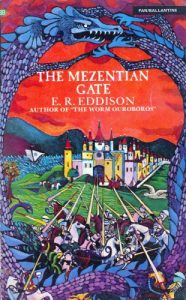 Both stories give me the basic enjoyment I expect to become from good fiction—the temporary immersion in imaginary but vivid and interesting lives (i.due east., there are characters) where the sequence of events makes sense (i.e., there'south a plot) and moves toward some kind of emotionally satisfying resolution (i.e., there's a denouement). Both stories as well requite me the distinctive enjoyments that I wait to go from a fantasy novel—the sense of wonder, the delight in a rousing tale, the peculiar rush that comes from taking in an imaginary globe where all the rules are different. Yet there'south something else present in the Eddison novel, something that'south present in the best fantasy novels—and also in the best of other kinds of literature—that'south simply not there in Lin Carter's endearingly clunky retreads of the pulp-magazine fantasies of his youth.
What Eddison's stories accept and Carter'southward lack, if I may slap a label on the feel and then go back and explain it, is a kind of mimesis.
 Art is a means—the but one we've come upwards with so far, despite a vast corporeality of tinkering on the role of assorted mad scientists—of enabling 1 person to share, in some sense, in another person'south experience of the world. Retrieve of the statue of Dainichi Nyorai, the Great Lord's day Buddha, we discussed ii weeks ago. The unknown sculptor who carved it was virtually certainly a Buddhist monk, and probable belonged to the Shingon school, 1 of the 2 branches of Japanese Buddhism that go into the mandalas and esoteric teachings nearly people these days associate with Tibet. His carving was an expression of the soaring spiritual vision at the heart of the Shingon school, the sense that this very world with all its follies and vices, just as it is, is the expression of the infinite aware consciousness symbolized by Dainichi Nyorai. Sit in front of the statue, open up yourself to information technology, and you can sense something of what that unknown monk experienced in his meditations, reflected in the piece of work of his easily. For a moment, you're not limited to thinking your own thoughts—you can feel at to the lowest degree a dim repeat of another's.
Turn to the other instance I cited two weeks ago, the Paris morning time streetscape by Louise-Joséphine Sarazin de Belmont, and the same principle applies. At that place are plenty of paintings of Paris that are right downwardly there with Lin Carter's fantasy novels in their enthusiastic deployment of pre-chewed clichés, simply this is non one of them. It's not Paris seen through your optics or the lens of a generic camera; it's Paris as Sarazin de Belmont saw information technology that morning, gazing out through a window of the Louvre, watching a domestic dog—not a generic dog, heed you lot, but that dog, at that moment—run out barking at that horse, seeing that dominicus through those hazy clouds, catching that one of the countless subtle moods of a Paris morning, and capturing information technology in pigment on sail.
The distinction betwixt platitude and personal vision is also the deviation between the two categories of fantasy mentioned above. Read a volume of Thongor of Lemuria and the thoughts that y'all're experiencing are utterly familiar, the generic mindset of pulp fantasy, replayed in an endless loop with only the most minor variations. Read a volume of the Zimiamvian trilogy and the thoughts you lot're experiencing are unique to Eddison. You get to see how someone else thinks and feels and experiences life. In the procedure, the range of thoughts yous're capable of thinking and feelings you're able to experience gets expanded. That's what I mean by mimesis: the experience of a piece of work of genuine art guides you toward new ways of being in the world.
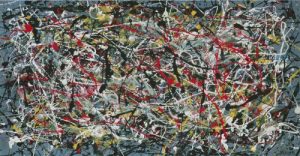 I don't become that experience when I wait at the bland, technically crude, utterly self-referential product of the current artistic avant-garde. Neither do the vast majority of people these days. Information technology's fashionable to insist that this is because the vast majority of people are incapable of affectionate real art, but permit u.s. please be real: until the terminal decades of the nineteenth century, that wasn't the case anywhere in the western world. Painters, sculptors, composers, dramatists, poets, and other producers of fine arts had the kind of fandom that rock stars have today, because they turned out brilliant works that ordinary people could understand and capeesh.
That changed only when artists bought into the notion that you can tell how skilful an artwork is past the number of people information technology excludes. That'southward when the visual arts fled from representational themes into brainchild, when avant-garde music abandoned tonality, when poets ditched rhyme and meter, and when the fine arts mostly embraced the pursuit of deliberate ugliness as a central strategy. If your artwork's supposed quality, and (more to the point) its chance of being approved by critics and snapped up past investors, depends on making sure that most people don't like it, removing everything from art that makes it appeal to audiences—well, other than the snob value discussed earlier—is a smashing fashion to fake artistic genius.
Every pendulum has its return swing, though, and the movement dorsum the other way is already taking shape. Truthful to class, it'south not taking shape among the habitués of the fine art scene, who are notwithstanding caught up in the trends simply outlined. It'south taking shape elsewhere, amid artists and audiences that accept embraced the tertiary definition discussed higher up—the idea that the point of fine art is to provide enjoyment to its audience—and who are moving in various ways toward the fourth definition, equally artists in any number of popular media reach the kind of personal vision that makes the feel of mimesis a source of delight for their audiences.
Information technology's safety to predict, in fact, that no one a century from at present volition call up the producers of the highbrow trash that currently clutters up art museums, conservatories, literary bookstores, and the like today. It's safety to predict that, in turn, because we've been here before. Plenty of Oxford and Cambridge graduates wrote masques for the English language upper classes in the sixteenth century; they're forgotten by everyone but a few academic specialists, while William Shakespeare and Christopher Marlowe, who wrote popular drama for the mass market, are still having their plays produced today. Many people live today volition recall "Oo, Those Awful Orcs," the 1956 essay in which the immensely influential critic Edmund Wilson dismissed J.R.R. Tolkien'south The Lord of the Rings as "juvenile trash;" Wilson is all but forgotten today and the fantasy author he preferred to Tolkien, James Branch Cabell, more thoroughly forgotten still, while Tolkien'due south trilogy is on track to be remembered as one of the 20th century's great works of literature.
Where the pendulum's swing might lead is an interesting question, and one that circles back to themes I've been discussing on this and previous blogs for some time at present. We'll talk over information technology farther in posts to come.
*********************
Meanwhile, with an eye toward moving from contemplation to activity, I have the first of 2 new writing contests to announce. (The second will be announced in a couple of weeks.) The conversations that followed last week's open post here revealed the fact that several regular readers and commenters are successful writers of romance fiction—the most unfairly despised of modern popular fiction genres—and I one-half-jokingly suggested an anthology combining that genre and the kind of deindustrial future explored in the four Subsequently Oil anthologies. I promptly fielded a flurry of requests from writers who wanted to submit stories, and so we're going to do information technology.
 Love in the Ruins will be an anthology of brusk fiction in the romance genre fix in the kind of future we're really going to get—a time to come shaped by the dull decline and fall of industrial civilization, brought about by the depletion of the natural resources on which it depends and the disruption of the ecological systems on which it's equally dependent. Infinite travel and the residue of the panoply of shiny new technologies with which people these days like to stock their imaginary futures? Forget about it. Instead, recollect economic wrinkle, the abandonment of high-terminate technologies, all the familiar processes through which civilizations slowly requite way to night ages and dark ages give style to the rise of successor cultures. (No, stories nigh apocalypse aren't of involvement either—those are only as hackneyed and unrealistic as the shopworn Star Trek fantasy of perpetual progress outward to the stars.)
In an age of decline and fall, or the ages of turmoil and rebuilding that come up later on it, people will still autumn in beloved. That'south the basic theme of the romance genre: 2 people autumn in love and, overcoming whatever obstacles stand in their way, live happily ever after. Stories accustomed for this anthology will follow that basic outline. Please note that I'm non specifying genders or, for that matter, species for the ii romantic leads; that's up to you. Sexual activity is fine, though please exit out the grunt-and-squirt sort of detail; if y'all want to practice an old-fashioned romance where the drapery comes down as the protagonists kiss for the first time, that'southward fine too.
I'm looking for fifteen or so brusque stories between 3,000 and 8,000 words, and will as well include one or two novelettes of up to 15,000 words. I'grand besides looking for iv to half-dozen poems, and it's only fair to notation that I'm seriously prejudiced in favor of curt poems rather than long ones, and of former-fashioned poetic forms rather than shapeless gratuitous poetry—write a sonnet, a villanelle, or something else that rhymes and scans elegantly and your chances of credence will get style up.
We'll exist using the same submissions method that worked then well with the Later Oil anthologies. In one case you've got your story written, mail service information technology on a costless website and then brand a comment on the nigh recent post of this blog, letting me and other readers know where they tin read it. Payment volition depend on the contract I work out with the publisher—yes, this is going to be published, and aye, information technology's going to be a paying gig; I'll post the details here every bit nosotros work them out.
So get to work with the long sultry glances in crumbling cities and the feverish kisses in sheltered glades in the tropical jungles of 30th-century Pennsylvania. All submissions must exist received by May 1, 2019.
Source: https://www.ecosophia.net/what-is-art-for/
0 Response to "S Art of the Deal Ghostwriter Said That the President Would ââåmurder as Many Enemies as North Korea"
Post a Comment